Wanhua 萬華

Showing posts with label Attractions. Show all posts

The Red House

The Red House (西門紅樓)

Location: No. 10 Chengdu Rd, Wanhua District, Taipei City
Hours: 11:00am – 9:30pm, Tuesday to Sunday (closing time extended to 10pm on Friday and Saturday)
Website: www.redhouse.org.tw
The Red House
The Red House, which is located at Chengdu Road, is a western-styled architecture designed by Kondo Juro and built in 1908. It was once Taiwan’s first public market and later became the entertainment center of Wanhua during the Japanese Colonial Rule. Subsequently, after the World War II, the Red House began to enjoy popularity among the westernised moviegoers through the screening of martial arts movies and local costume films, etc. Nevertheless, business declined due to the stronger emphasis on eastward urban developments. Fortunately, in 2007, the Taipei Culture Foundation was commissioned to operate the Red House. Under their operation, this iconic site was transformed into a must-visit landmark. Today, the Red House continues to showcase a plethora of performances varying from Jazz to Taiwanese Opera.

Central display area
Apart from showcasing performances, exhibitions such as Kai-Hsing Hung Solo Exhibition and The Cradle of Cultural Creative Dreamer are also available on a seasonal basis. A small gallery is also set up at the entrance which vividly describes the history of The Red House through the display of some artifacts. 

Exhibit found at central display
Furthermore, interesting designer products can also be found at The Red House’s Creative Boutique. This includes hand-made rings to metal robots keychain. While the products sold may be pricier than other products found along the Ximending Street, the former are much more exquisite. 


Products sold at the Red House's Creative Boutique
Interesting Facts 
The market’s entrance takes the shape of an octagon which Chinese perceive as “Eight Trigrams” (八卦). According to Chinese fengshui, such design is symbolical of protection and luck.

The golden age of performance was from 1945 to 1963. During this period of time, The Red House held a wide variety of performances including Peking Opera, Cantonese Opera, popular music, dance shows, comedy routines and dramas.

The Red House was awarded the 7th Urban Landscape Award in Historical Space Redevelopment Category in 2008.

Throughout 2009, it has hosted over 1,000 arts and literature themed events

Exhibit celebrating the Red House's 104th Birthday
Therefore, with a strong and unique culture and tradition, The Red House is definitely one of the must-go tourist attractions in Taipei. 

Directions 
MRT: Take to Ximen MRT station and exit at Exit 6. The building is found on the left side of the exit, one pedestrian crossing away.

Bus: Sanchung-bus (Wugu-Taipei, Jhonggang-Beimen, Huilong-Taipei) 3, blue 2, 9, 12, 18, 25, 49, 52, 201, 202, 205, 206, 209, 212, 218, 221, 223, 231, 232, 233, 234, 235, 253, 257, 513, 624, 621, 640
0

Jia Na Festival

Jia Na Festival (萬華加蚋文化節)

All Photo Source: http://www.whdo.taipei.gov.tw
Massive beansprout picking event
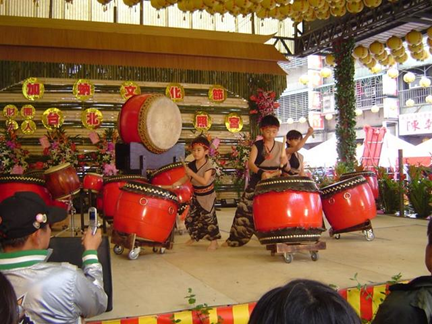
Jia Na Festival (加蚋文化節)is an annual festival celebrated by many Wanhua locals on March 12 (Lunar Calendar). It is usually commenced outside a temple before activities encompassing themes comprising forklore, sports, education, religion, business and aboriginal arts kick start the week. 


These multi-cultural events often attract large crowds of participants and on-lookers. At the same time, it also reminds participants of the past and traditional cultures which their ancestors once practiced. 

A lively festival cherished by many, a significant activity of this festival involves honoring the deity, 保仪大夫神 through having the temple troupes touring Wanhua’s area. In this past, locals pray to this deity in hope to exterminate pests that are destroying their crops. However, as the country progresses, the number of farmers have declined. Thus, most locals now pray in hope for peace and development. 

Religious rituals performed by temple troupes.
Apart from the religious rituals, different clubs and associations also get a chance to showcase their talents. For instance, performances by locals are varied, ranging from line dancing, modern contemporary dance to having live bands perform. Other community wide activities held include a massive beansprout-picking event. Having celebrated this festival for 13 consecutive years, it is proven that this festival holds a unique place the residents’ hearts.

Exhibitions showcasing hand braided products
Specific photo source: http://www.whdo.taipei.gov.tw/lp.aspctNode=3428&CtUnit=2062&BaseDSD=7&mp=124111
0

Guiyang Street

Many streets of Wanhua have significant and unique historical origins. For instance, Gui Yang Street (貴陽街) is Taipei’s oldest street and the street that then Monga first prospered. While this street no longer holds the economic significance it once held, it still houses an entire stretch of traditional shop houses which allows one to take a quick glimpse and feel of Wanhua’s current state. During the Japanese Colonial Rule, the street was divided into 2 sections, namely "Wen Wu Ding" and the other comprises places called "Zhu Ding" and "Ru Chuan Ding". Even earlier, Gui Yang Street was shorter as it was divided to about 5 different portions such as Sweet Potato Street (番薯街), each representative of activities carried out in the area. For instance, Sweet Potato Street was named due to massive sweet potato trading in that district. Today, one will be able to find century old outlets selling incense or traditional pastries as well as famous temples Chin Shan Gong (青山宮) and Ching Shui Temple (祖師廟) within its vicinity.

Vendor selling Liang Fen (涼粉)
This is probably the only Liang Fen food stall left in the entire Wanhua. This special snack is cool on the inside and thus extremely enjoyable to savour when the weather is hot.

Liang Fen
Despite the rich historical background of Gui Yang Street, many locals have forgetten it after its decline. This is due to the shift of economic focus from the west to the east of Taipei. Nevertheless, it is heartwarming to know that non-profit organisations in this district remain passionate about promoting the place’s history and culture. This results in events such as free-guided tours around Gui Yang Street for interested parties to gain a deeper understanding of the place.

One of small alleys of Gui Yang Street. In the past, these small alleys hold great significance to the locals’ lives.
A free tour organised by the district’s activists.

Interesting Facts

Fun Fact 1
In the past when Tamsui River was clear, there were a lot of performances such as "Hua Ren" and "Kong Jing". A myriad of fishes and clamps could also be found in the water. However, this water pathway is now almost gone due to massive sand disposition and reduced water flow. Ships can no longer enter the river and this halted the development of Gui Yang Street.

Fun Fact 2 
Traditional performances known as "Ge Zai Xi", or "Nagaxi" were popular during the Japanese Colonial Rule at this old street. In the past, this area happens to be a gathering location for mafia and there would be public fight for new territories. While the situation in this street was dangerous and sketchy, Gui Yang Street today is much quieter and peaceful.

0

Hong Bao Chang

Hong Bao Chang (紅包場) is a form of Taiwanese Cabaret (i.e. karaoke) popular among the Taiwanese older generations. 


It started in the 1960s, with performances usually targeted at the army soldiers from Mainland China for entertainment purposes. In Wanhua, this form of past time was commonly held along San Sui Street (三水街). However, as Wanhua undergoes development and revamp, these karaoke sessions have been shifted to places such as the basement floors of Long Shan Temple Station (龍山寺站) and within shop houses along Ximending Walking Street (西門町).


Today, these sessions involve singers performing to famous Taiwanese or Hong Kong pop songs from the 1970s, such as “Unforgettable” (意難忘) and “The Moon Represents My Heart” (月亮代表我的心).  In addition, friendly interactions such as cracking jokes between the audience and the performer are usually carried out to build a stronger rapport between both parties. In return, many of these singers receive red packets during their performance as a form of appreciation for their talent.


While these sessions may not be as commonly seen as before, it remains representative as one of the favourite past times carried out by the older generations in Wanhua. After all, Wanhua, being the oldest district of Taipei is heavily populated with the aged. 
0

Herbal Lane

Location224 Lane, Xichang St. Taipei 
Hours: Varies by store
Directions: Exit 4 from Longshan MRT Station


Herbal Lane is a street next to Longshan Temple that is strikingly green with all the herbs and health products that are sold there. In the past, when people prayed at the Longshan Temple they not only learned information about their life fortune but also the state of their health. Depending on the person, those at the temple will prescribe certain herbs to the temple visitors that will improve their health thus creating a demand for herbs next to the temple.


Nowadays, herbs are still the main focus of the street but there are also food carts selling fruits and herbal tea drinks. Even if you don’t need herbs to improve your health, take a stroll down this lane and discover plants that you have never seen before!


2

Ching Shui Temple

Location: No. 1號長褔街 Sanxia District, New Taipei City, Taiwan 237
Hours:
 7 days a week from 4:00am-10:00pm
Phone:+886 2 2671 1031


The full name of the temple is Ching Shui Yen Tsu Shih Temple and it is located in the Wanhua district of Taipei. The temple was built during the Ching Dynasty (aka Qing Dynasty) in 1787 A.D. It is one of the oldest temples in the area and is special because it doesn’t worship the Buddha or traditional deities but a person. He was a well-respected monk so the people built a temple for him after his death. He is regarded as the guarding deity for An-Hsi immigrants to Taiwan.


There is a legend behind why the deity’s face is black. It is said that one time when he was meditating alone in the mountain, he came under the attack of ten demons. They set him on fire for seven days and nights straight but only his face was burnt because of his strong faith. The demons were impressed and four of them decided to follow him and become his guards.


Other than celebrations on Chinese New Year, there are also celebrations on Ching Shui deity’s birthday on January 6 of the lunar calendar. The ritual performed is called 禮斗 (Dipper Worship). A large pale is filled with rice to signify good harvest, then a fan and a sword is inserted into the rice. They are all items to help build prosperity in the future.

There are some English signs located at this temple for tourists and the employees are learning foreign languages to better educate visitors on the history of Ching Shui temple.


0

Chin Shan Gong Temple

Chin Shan Gong (Monga Castle Palace)
Location: Wanhua District in Taipei, Taiwan, Guiyang Street, No. 218, Section 2

Hours: Sunday to Saturday from 5:30am-9pm
Est’d date: approx. 1853 (160 yrs old)
Time period: colonial period, Qing Dynasty
Religious affiliation(s): Buddhist/Taoist
Type: Taiwanese religious folk temple
Origin of name: Lingan Zunwang (Castle King)


Facts: Tzang Wei Quan, also known as Qing Shan Ling An Zun, was a General who came from a region called Hui’an, a county that is under the jurisdiction of the prefecture-level city of Quanzhou, Fujian, China. The general was well respected and recognized man among the locals of Wanhua because of the many victorious battles he had lead; however he is not an internationally recognized patron or god, but nevertheless, an important man. According to the locals, during the journey of which the statue of the patriarch was carried, it was placed on top of a well in the afternoon for a rest. However, the statue could not be moved when the carrier decided to continue with their journey. This explains the location of the temple. Rumour also spread that smoke once diffused from the well, leading to a passer-by fainting. 

On October 20-22 on the lunar calendar, an elaborate festival in his name is held during these days. On the first day (October 20th), rituals and parading around town is done in the south end of Wanhua. On the second day (October 21st), the rituals and parading moves into the centre town of Wanhua, and lastly, on the third day, the festivities reach the remaining areas of Wanhua. 


On a daily basis, at around 4pm, the caretakers and members of the temple perform rituals and parade around town in traditional costumes, which can be seen inside the temple behind glass cases. Because of its historical importance, it has been deemed one of three national monuments by the Ministry of Interior Affairs in 1985. The temple is said to have an aura that warded off/ eliminated the illnesses like the plague back then, as well as acting as a place that presided over judicial actions-award the good and punish the evil. Like many other temples in the Wanhua, the architectural elements of this temple does not fall short of any grandeur, with its hand painted and wood-carved detail which can be seen throughout the interior of the temple, and on the tops of its roof, which is laden with beautifully carved dragon pieces made from wood. 


This temple has three stories worth of memorizing historical architectural work, and each level of the temple is devoted to specific individuals. The first level is devoted to General Chin Shan Gong, the second level is devoted to his wife, and the third level is devoted to the Jade Emperor. The exterior of the temple is mostly built from a dark slate coloured stone, which gives this temple quite the olden look.


Fun Fact 1: If you look on the inside of the entrance door’s panels, you will see both panels painted in the image of the Castle King, and if you stare into his eyes long enough and walk in either direction…the eyes will appear to follow you around the room!
Fun Fact 2: This temple was said to have stopped the SARS epidemic from reaching and taking over the area.
Fun Fact 3: The trigram as seen in the picture below, is almost extinct today. The trigram is special as it does not involve the utilisation of any nails, but depends merely on wooden wedge. 


Fun Fact 4: The most expensive part of the entire temple's architecture is known as "Jiao Zi Tou".


0

Bopiliao Historic Block

Brief Introduction


Bopiliao Historic Block is one of the key attractions of Wanhua District that portrays some of the oldest and most historical architectures in the modern city life of Taipei. With a long history dating back to 1799 when it was first known as “Fupiliao” (福皮寮街), this street has been revamped, and officially opened to the public in 2009 again with a new appearance. Today, it serves not only as a preserved attraction popular among tourists but also a site that reminds and educates the locals of their traditional culture and history. This includes a wide range of traditional shop houses from the Qing dynasty (1683 - 1895) to buildings constructed during the Japanese occupation, (1895–1945) till early post war periods. 


Bopiliao lies within Kangding Road, Guangzhou Street and Kunming Street in the Wanhua District and is one of the most complete historical streets conserve in Taipei City. Some of its significant historical meanings include being the main route from Bangka to Guting Village in the Qing Dynasty. The end of Bopiliao Street used to be an important military base during the Qing Dynasty, as well as this street has witnessed the development of Bangka district. Therefore, centuries Old Street like Bopiliao has been successful in impressing visitors who are interested in gaining a deeper understanding and exposure of Taiwan’s rich and deep history.

The Education Center of Taipei City
This education center, being the gem of the Bopiliao Historic Block, is a must-see historic tourist attraction. Opened in 2006, it aims to collect, summarize and promote native history and culture while managing and incorporating this information into local education courses to enhance local students’ knowledge of the history and culture of Taiwan.

Within the education center are exhibits which describe the history of Bopiliao and its historical role in the Wanhua district. This includes introducing the progressive development of place names, specific features of architecture types and stories of old stores and of legendary influential people that made a difference in Taiwan (eg. George Leslie Mackay).

Snapshots of the exhibition

An interactive puzzle that informs visitors how the name of this historic street has changed over the years. E.g. During Qing Dynasty, the street was named Fudiliao Street.

Basic furniture used by the Taiwanese in the past. 

A view of the street from 2nd level of the Education Center.
On top of this, there are permanent exhibitions showcasing traditional Taiwanese education such as its imperial examination system to the medical developments in Taiwan. Other ad-hoc exhibitions change on a seasonal basis such as showcases on puppets.


The Medical Development Exhibition vividly showcases the different herbs and traditional medicine used by locals in Wanhua as well as how a typical Chinese Medical Hall would look like in the past. It also gives an overview of key doctors that helped to shape the medical field in Taipei today. 


A simulation of a classroom setting in Taiwan.
An ad-hoc exhibition that showcases traditional stage puppets. 


Contact Information
Tel: (02) 2336-1704
Website: http://hcec.tp.edu.tw
Hours: 9:00 – 17:00 Tuesday to Sunday. Closed on Mondays and holidays.

Other Historical Scenes
Along the street used to be shop houses such as Sun Book Binding Company (one of the earliest binding company in Taiwan) and the residence of famous doctors like Dr. Lu Chang.


While the facades of these shop houses remain, these places now house interesting exhibits with a wide variety of themes. This may include some art exhibitions that display architecture designs to abstract paintings.


Interesting Facts
The name “Bopiliao” has interesting origins. Some stories illustrate how the name was derived from the processing of tree barks while others used the peeling of cow skin as an apt explanation of how its name was first introduced.


Community projects initiated by Non-governmental Organisation at Bopiliao is common. As they aim to revive people’s adore and love for Wanhua, events such as inviting the old store, Changshou Tea Shop back to its original location for a day has been carried out. These activities aim to not only enhance greater cultural awareness among Wanhua residents, it also allow the older generations to reminiscent one of their favourite past time – to enjoy tea with a group of old buddies at Bopiliao. 

Directions / Methods of transportation to this destination(with map) 
Bopiliao lies within Kangding Road, Guangzhou Street and Kunming Street in the Wanhua District. It is locaed along Lane 173, Kangding Road, beside Laosong Elementary School.


Address: No. 101 Guangzhou St., Wanhua Dist., Taipei City 108, Taiwan (R.O.C)

By Taipei Metro: LongShan Temple Station (ShiYuan Road)
Buses to Longshan Temple Station:
Herping West Road:
1, 231, 234, 245, 263, 264, 265, 265 (right), 265 (left), 265 (night), 265 (interval bus), 628, 651, 656, 657, 658, 701, 702, 703, 703 (sub-line), 705, 907, Herping Line, blue 28, 201, 49, 527
Shiyuan Road:
49, 527, 673, 234, 265, 265 (right), 265 (left), 265 (night), 265 (interval bus), 38, 628, 673, 7
Kangding Road:
201, 205, 229, 231, 234, 242, 264, 38 (interval bus), 601, 62, 624, 628, 658, 701, 702, 703 (sub-line), 705, 9, blue 29, 49, 527

By Rail: Wanhua Railway Station

Lao Song Elementary School (Guanlin Road)
218, 218 (direct), 302, 628, 673, bleu 29

LongShan Junior High School (Naning Road)
202 (interval bus), 231, 245, 263, 265, 265 (right), 265 (left), 265 (night), 265 (interval bus), 310, 38, 601, 656, 657, 658, 701, 703, 703 (sub-line), 9
1